
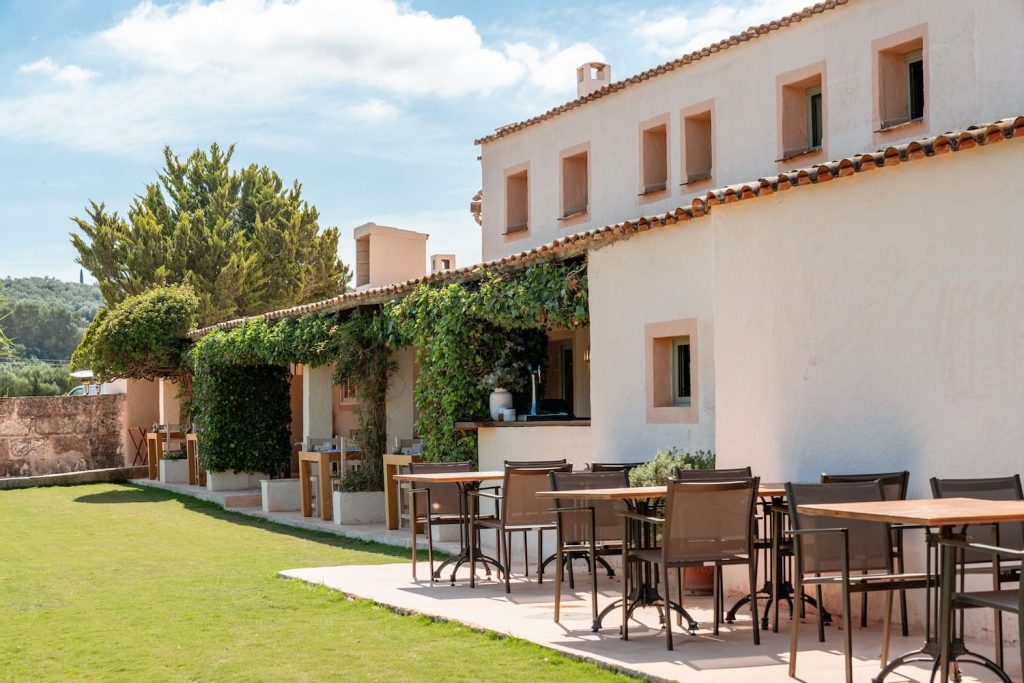
Agritourism accommodation is located on a working farm, established before 1961, with a maximum of 12 rooms. In 2026, it remains the most authentic way to sleep in the Mallorcan countryside: in 2025, agritourism establishments in the Balearic Islands welcomed 522,271 travelers and recorded 1,685,111 overnight stays, and the typical agritourism accommodation (55%) has between 6 and 10 rooms. Es Mayolet, in Manacor, fits the bill perfectly: 28 hectares with its own vineyard and only 10 rooms.
If you're wondering what agritourism is, the short answer is this: accommodation located on a working farm. It's not a hotel with a view of the countryside. It's sleeping on a real working farm, with its vegetable garden, vineyard, or livestock just a few meters from your room. And here's the key: in Mallorca, this isn't just a marketing label, but a regulated category with its own legal requirements. A good agrotourism in Mallorca it combines relaxation with a connection to the surrounding land. The truth is, the concept has grown considerably, and with it, the confusion between agritourism, rural guesthouses, and rural hotels. In this guide, we separate the categories, review the activities they offer, explain the requirements of Balearic law, and show you how to choose the one that truly suits your needs.
What is agritourism and how does it differ from a rural house?
In simple terms, what is agritourism? It's accommodation on a working farm that combines lodging with authentic rural life. A rural house, on the other hand, is simply a traditional dwelling in a rural setting, without any requirement for it to have a farm or livestock operation. That's the difference.
The difference seems small. It isn't. In an agritourism establishment, what you see through the window is part of the business: the vineyard is harvested, the vegetable garden is cultivated, the animals are cared for. A rural house can be in the middle of the forest and be a marvel, but it isn't obligated to produce anything. That's why agritourism has a component that a rural house doesn't guarantee: the land being used. At Es Mayolet, that vineyard and that vegetable garden aren't just for show; they supply the restaurant's kitchen and dictate the rhythm of the farm according to the season.
What activities can you do at an agritourism establishment?
It depends on the estate, but a good agritourism experience in Mallorca revolves around the land, tranquility, and gastronomy. It's common to combine rural experiences with pure relaxation: exploring the vineyard, eating produce from their own garden, horseback riding, or simply doing nothing under a fig tree. Here, time is the true luxury.
These are the most frequent activities:
- Tours of the estate and vineyard, on foot or on horseback, to understand how the land is worked in the Llevant region.
- Garden-to-table gastronomy: tasting menus with organic produce picked that same morning.
- Horse riding and picnic & ride experiences, a horseback riding outing that ends with an outdoor basket.
- Swimming pool, reading and silence, the hardest plan to find on the coast in high season.
- Wine tastings and experiences when the estate produces its own wine.
What few people know is that the star attraction is often the simplest activity: a leisurely breakfast, enjoying fresh, local produce. However, it's advisable to book horseback riding excursions and tastings in advance, as group sizes are small. You have the details of the experiences on a farm in Mallorca you can enjoy without leaving the property in our guide.
What is the difference between an agritourism establishment and a rural hotel in Mallorca?
The confusion is constant, and there's a simple solution: they are two distinct legal categories. An agritourism establishment is located on smaller farms with mandatory agricultural activity and fewer rooms; a rural hotel in Mallorca it accepts older, larger properties, more rooms, and a mandatory restaurant. One isn't better than the other; they're simply looking for different things.
| Criterion | Agritourism | Rural hotel |
|---|---|---|
| Age of the property | Prior to 1961 | Prior to 1941 |
| minimum area | 10 continuous hectares (Mallorca) | Larger area |
| Maximum number of rooms | 12 | 25 |
| Active agricultural holding | Mandatory | Not mandatory |
| Restaurant | Optional | Mandatory |
In practical terms: agritourism is more intimate and closely tied to farm production; a rural hotel is larger and functions more like a character hotel in the countryside. If you're looking for a few rooms and want to experience the farm firsthand, agritourism is the option for you.
What legal requirements must an agritourism establishment meet in the Balearic Islands?
In the Balearic Islands, agritourism is regulated as a complementary activity to agricultural holdings: it cannot exist without cultivated land behind it Agrarian Law of the Balearic Islands this framework is established, and tourism regulations specify the official classification. Without actual development, there is no agritourism. This is the defining requirement.
The key requirements of Balearic regulations are as follows: The property must predate 1961 and have an active agricultural, livestock, or forestry operation. In Mallorca, the minimum farm size is 10 contiguous hectares. The number of rooms cannot exceed 12. And the accommodation must be integrated into the farm's activities, not the other way around. Es Mayolet easily meets these requirements: 28 hectares with its own vineyard and only 10 rooms place it squarely in the agritourism category, not just as a sales pitch, but as a registered fact. When someone sells you "agritourism" without a working farm, something doesn't add up.
What types of agritourism exist in Mallorca?
Not all agritourism establishments are the same, and choosing well starts with knowing what kind of experience you're looking for. In Mallorca, several types coexist, depending on what the farm produces and the level of service. These are the main ones:
- With or without a restaurantSome offer only bed and breakfast; others, like farm-to-table, revolve around their cuisine.
- With vineyard or olive oil tourism: estates that produce their own wine or olive oil and offer tastings and visits to the winery or mill. It's the natural gateway to wine tourism in Mallorca right from your room.
- Ecological: organic farms with certified or organic practices, chemical-free gardens, and seasonal produce. This is the model that fits with the sustainable tourism in Mallorca that more and more travelers are looking for.
- Luxury or slow luxury: few rooms, restored Mallorcan architecture and an idea of luxury understood as time, silence and space.
The Luxury agritourism in Mallorca it's the fastest-growing category. And not because of the marble or the extras: it's growing because many people have realized that true luxury, on an island overcrowded in the summer, is having space to breathe.
How to choose a good agritourism in Mallorca?
Choosing well is about looking beyond the pretty picture. A worthwhile agritourism establishment has a real estate, a limited number of rooms, and consistency between what it promises and what it delivers. Before booking, review these criteria and compare carefully. Avoid surprises. To give you an idea of what we mean, here's our rural estate in Mallorca: 28 hectares with orchard, vineyard and horses.
- That it has a truly active agricultural operation: vineyard, orchard or livestock in production, not a decorative garden.
- Few roomsThe fewer the guests, the more intimacy and silence. Ten or twelve make a difference compared to thirty.
- Origin of the product in the kitchen: ask if the letter comes from their own garden or from any supplier.
- Location and surroundings: quiet interior versus crowded coast; a stay at an agritourism establishment in Manacor and the Llevant region gives you open countryside far from the hustle and bustle.
- Authentic architecture: restored Mallorcan stone, not a new construction disguised as rustic.
- Opening SeasonMany are open from April to October; confirm dates and what activities are available.
What is the best time to visit a farm stay in Mallorca?
The best time to visit is from spring to early autumn, with two particularly pleasant periods: May-June and September-October. These are the months when the countryside is at its peak, the weather is mild, and the island is less crowded than in July and August. Most agritourism establishments, including Es Mayolet, are open precisely from April to October.
In spring, the orchard and vineyard are bursting with life, and the lush greenery of Llevant is breathtaking. Autumn, with the recent harvest, offers a color and light that make the trip worthwhile. If you'd like to learn more, here's what you need the best time to visit Mallorca depending on the type of plan. However, high season means booking in advance: small properties fill up quickly and don't accommodate large groups. The growth of rural tourism in Spain confirms this: in 2025, 12.87 million overnight stays were recorded, a 1.21% increase, according to the INE.
Frequently asked questions about agritourism in Mallorca
How many rooms can a rural tourism establishment in Mallorca have?
An agritourism establishment in Mallorca can have a maximum of 12 rooms according to the Balearic tourism classification. This limit is designed to maintain an intimate scale and consistency with the estate. In fact, according to IBESTAT, the 55% rural accommodations in the Balearic Islands typically have between 6 and 10 rooms. Es Mayolet, with 10 rooms spread across 28 hectares, falls squarely within that exclusivity range, far removed from the overcrowding of a conventional hotel.
What is the difference between agritourism and rural tourism?
Rural tourism is a broad concept: any accommodation or tourist activity in a rural setting, including country houses, rural hotels, and agritourism establishments. Agritourism is a specific category within this umbrella, requiring an active farm. In other words, all agritourism is rural tourism, but not all rural tourism is agritourism. The difference lies in the working farm, which is mandatory in agritourism and defines the experience. If you'd like to see how this works on a farm in Manacor, take a look at our page on rural accommodation in Mallorca.
How much does it cost to stay in a rural tourism establishment in Mallorca?
Prices vary considerably depending on the category, season, and services. A standard agriturismo might be priced similarly to a mid-range hotel, while a luxury or slow luxury agriturismo, with a limited number of rooms and a tasting menu restaurant, falls into the premium segment. Factors influencing the price include the time of year (May and September are generally more balanced than August), whether half-board is included, and the experiences booked. At exclusive estates like Es Mayolet, rates are provided upon request, based on dates and length of stay.
Where does the concept of agritourism come from?
Agritourism stems from a simple idea: opening farms to visitors to diversify rural income without abandoning agricultural activity. In the Balearic Islands, it was established as a legal model precisely to protect historic farms and their operation. Understanding its origins helps us grasp what agritourism is today: not just another rural hotel, but a model that keeps the land alive while providing a place to truly relax.
Why choose an agritourism establishment in Mallorca for your next getaway?
Because understanding what agritourism is changes your expectations of a trip. You're not going to accommodation with a view of the countryside: you're going to sleep on a living farm, with its vineyard, its vegetable garden, and its own rhythm. On an island that rushes by in the summer, agritourism in Mallorca gives you back what's precious: time, silence, and space. If you're looking for exactly that—10 rooms, 28 hectares, and garden-to-table cuisine in the heart of Manacor—discover our Luxury agritourism in Mallorca and book your getaway. The Llevant countryside is waiting for you.