
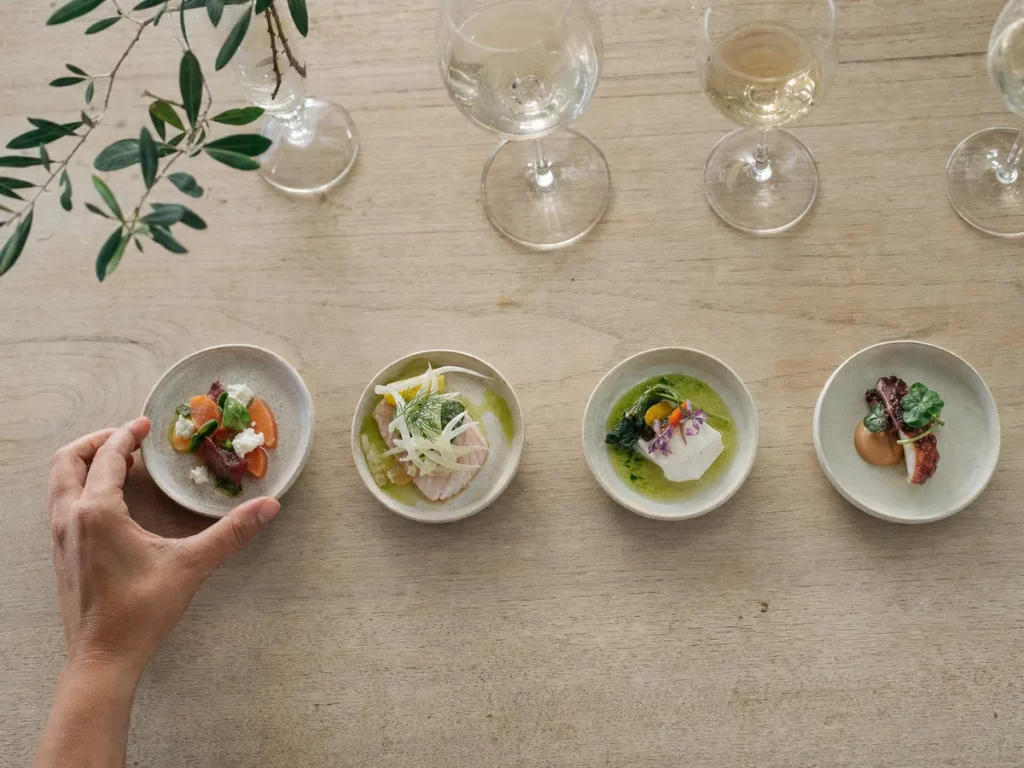
A tasting menu is a set sequence of small dishes chosen by the chef, served in an order designed to progress from subtle to intense flavors. The average Spanish tasting menu consists of between 6 and 9 courses, although some have as few as 4 and others more than 30. It lasts between two and a half and four hours, and in 2026 the price ranges from €38 at a restaurant with its own produce to over €200 at a two-Michelin-starred establishment. Wine pairings are charged separately and typically add between 50% and 70%.
Almost everything that has been written about the tasting menu is aimed at the restaurant trade: how to design it, how to work out the costing, how many courses to serve. Very little is written for whoever sits down at the table and wants to know what to expect. This guide is about that: how many courses will come out, how long it will last, what happens if you have an allergy, whether you can order something else and when, frankly, it is not worth it.
What is a tasting menu and how does it differ from an à la carte menu?
A tasting menu is a fixed offering: the restaurant decides the dishes, the order, and the quantities, and you accept the whole package. An à la carte menu works the other way around—you choose, the chef prepares. The practical difference is that with a tasting menu you sample more dishes in smaller portions and you relinquish the decision-making power.
It's not a matter of luxury. A tasting menu can be haute cuisine or a four-course seasonal menu in a country house. What defines the format isn't the price, but rather that the selection is made by the chef.
And there's a fundamental reason why chefs like it: they can buy better. If they know that all the diners will be eating the same thing, they buy the exact amount of fresh produce and don't have to carry around a menu with thirty items that requires a fully stocked refrigerator.
How many dishes are in a tasting menu?
The average Spanish menu consists of between 6 and 9 courses, including appetizers and desserts. Menus with fewer than 6 courses are usually considered seasonal or short menus; those with more than 12 are considered long menus. The so-called "exhibition menus" of some avant-garde restaurants can reach 30 or 40 courses, but these are the exception.
The usual layout of a 7-course menu works like this:
- Appetizers or snacks: one or two bites in one gulp.
- Cold starters: seasonal vegetables, pickled foods, raw foods.
- Hot starters: broths, short stews, garden produce.
- Fish: the first protein, with a light sauce.
- Meat: the heaviest dish on the menu.
- Pre-dessert: citrus or dairy, to cut the fat.
- Dessert: and often, some closing petits fours.
A longer menu doesn't necessarily mean a better one. After a certain number of courses, the palate becomes saturated, and many chefs know this: well-constructed 4- or 5-course menus are often more memorable than 15-course ones.
How long does a tasting menu last?
A tasting menu of 6 to 9 courses lasts between two and a half and three and a half hours. With wine pairings, it takes longer, because each change of glass adds an explanation. Longer tasting menus of more than 12 courses can last four hours or more.
This has a practical consequence that ruins many reservations: a tasting menu isn't compatible with a flight that same afternoon, a theater ticket, or a business lunch that needs to end by a specific time. If you have commitments afterward, mention it when you book; some restaurants can shorten the menu, and others will simply recommend you come back another day.
How much does a tasting menu cost in Spain and in Mallorca?
In 2026, the range is very broad because the format is used by very different restaurants. This is the actual benchmark:
| Type of restaurant | Price per person | Usual number of passes |
|---|---|---|
| Farm or restaurant with its own produce | €38 – €60 | 3 – 5 |
| Signature restaurant without a star | €60 – €110 | 6 – 9 |
| One Michelin star | €120 – €190 | 8 – 14 |
| Two Michelin stars | From €200 | 10 – 18 |
In Mallorca, the range is practically the same, with one peculiarity: the island has an unusual number of estate restaurants with short menus and produce from their own gardens, which occupy the lower end of the scale with a quality of product that doesn't correspond to their price. If you want to see who's playing at the top, we have the updated list of Michelin-starred restaurants in Mallorca.
To compare prices and distinctions before booking, the two references that publish verified reviews of each restaurant are the Michelin Guide and the Repsol Guide. The official list of gastronomic establishments and events on the island is maintained by the portal Balearic Islands Travel.
What is food pairing and is it worth including?
The wine pairing is a different glass of wine for each course or every two courses, chosen by the sommelier to complement that specific course. It is arranged separately from the menu and in Spain usually adds between 50% and 70% to the price, although shorter, more affordable pairings are available.
It's worth it when the restaurant serves wines you wouldn't find on your own—small productions, local varieties, specific vintages—and when there's someone on the server who can explain them. It's not worth it if you're driving, if you don't drink much, or if the restaurant can't tell you in advance which wines are on the menu.
There's an alternative that almost no one offers by default, but almost everyone will accept if you ask: a half-glass per course, or a wine pairing with only three of the dishes. It doesn't cost much to ask.
What if you have allergies, intolerances, or are a vegetarian?
You need to notify them when you book, not upon arrival. These kitchens buy ingredients based on the number of confirmed diners and plan the menu days in advance; informing them of an allergy upon sitting down means, at best, eating a hastily prepared version that's worse than what everyone else at the table is eating.
With prior notice, most restaurants will adapt their entire menu at no extra charge. Severe allergies—nuts, shellfish, gluten (celiac disease)—should be specified in writing, as traceability in a multi-course kitchen is more complex than with a short menu. Many establishments already offer a separate menu for vegetarian and vegan dietary restrictions.
What is a Table d'Hôte menu and how does it differ from a tasting menu?
The Table d'Hôte is the classic French format for a host's meal: a single menu of the day, with no choices, featuring whatever is available in the pantry that day. It's similar to a tasting menu in that the kitchen makes the decisions, but it differs in two ways: it's usually shorter and changes literally every day, depending on what's available at the market or in the garden.
It is the natural format of country houses, because it fits how a kitchen garden works: you do not cook what the menu says, you cook what is ready to be harvested. At Sa Vinya d'es Mayolet, the table at Es Mayolet, an agrotourism in Mallorca in Manacor, the Table d'Hôte consists of four courses and is made with produce from the estate itself under the gastronomic direction of Andreu Genestra.
The advantage for the diner is twofold: you pay less than for a long tasting menu and you eat produce that was harvested that morning. The disadvantage is obvious: you don't get to choose. If that bothers you, this format isn't for you.
When NOT to order a tasting menu
- If you have a later appointment. Three hours on average is normal. It is not a format compatible with a schedule.
- If you are very selective about what you eat. You're giving up on choosing by definition; if there are five ingredients you can't tolerate, the menu is a better idea.
- If you are in a large group with diverse tastes. The menu is the same for the entire table, and multiple exceptions overwhelm the kitchen.
- If you're looking for quantity. The portions are small by design. You leave feeling satisfied, but it's not a feast.
- If it's your first meal of the trip and you arrive with jet lag. It sounds silly, but it's the most common mistake: you get little enjoyment and you pay the same amount.
Frequently asked questions about the tasting menu
Is it possible to order a tasting menu for just one person at the table?
It depends on the restaurant. Many require the entire table to order a tasting menu because the service is synchronized with each course, and ordering à la carte throws off the kitchen. Others allow it without a problem, especially with shorter tasting menus. It's the first question you should ask when making a reservation if the table doesn't agree.
How many dishes are in a tasting menu at a Michelin-starred restaurant?
Between 8 and 14 courses is typical in a one-Michelin-starred restaurant, including appetizers, pre-dessert, and petits fours. Two-Michelin-starred restaurants often offer up to 18 courses. Many also offer a shorter version, with 5 or 6 courses, usually available only at lunchtime and considerably cheaper than the longer dinner menu.
Is it mandatory to book a wine pairing with a tasting menu?
No, it's never mandatory. You can order from the menu and choose a bottle from the wine list, or simply drink water. Wine pairing is an extra that you book separately and that usually increases the bill by 50 to 70%. Many restaurants also offer short pairings or half a glass per course if you request it.
How much does a tasting menu cost in Mallorca?
In Mallorca, prices range from around €38 per person in country houses and farmhouses with a short menu featuring local produce, to over €200 at the island's two-Michelin-starred restaurant. The middle ground, for independent chef-driven restaurants without a star, ranges from €60 to €110. Drinks are almost never included unless specifically stated.
Is it possible to have a second course on a tasting menu?
As a general rule, no, because each course is plated in the exact amount for the number of confirmed diners. It is common for them to offer extra bread and, in some establishments, an appetizer. If you leave hungry, it's reasonable to mention it at the table: many restaurants will gladly offer an extra course or an additional dessert.
Try a Table d'Hôte with its own garden in Manacor
If you're drawn to the idea of a tasting menu but not the price or the three-hour ceremony, the four-course format at Sa Vinya d'es Mayolet is the perfect middle ground: the kitchen decides, the produce comes from the estate's garden, and the meal fits into a reasonable after-dinner conversation.
Book on +34 971 845 685 or at info@reservarotana.com. The menu changes every day depending on what's available in the fields, so no two visits are the same.