
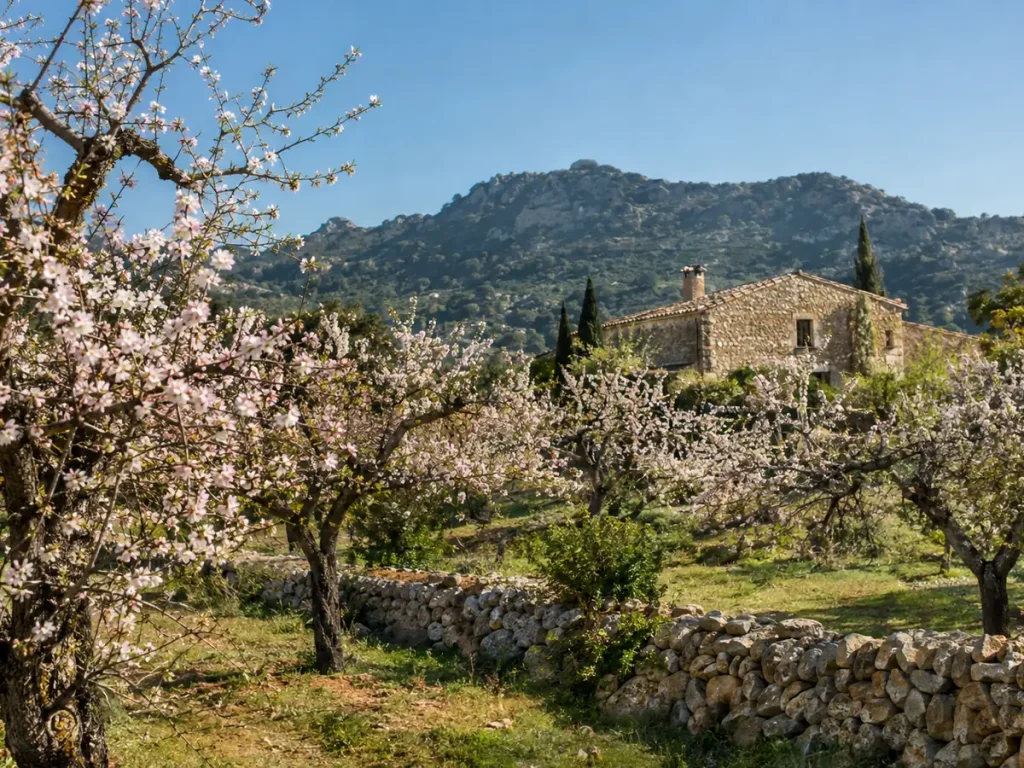
Mallorca's almond trees blossom from late January to late February, depending on the year, and February is almost always the peak month. In 2026 the blossom came early around Palma because the cold arrived early, according to the IRFAP. The largest fields are in the Pla, the Llevant and the valleys of the Tramuntana. In February, Palma reaches highs of around 15 °C and Son Servera holds the Fira de la Flor d'Ametler.
There's a week each year when the interior of Mallorca looks like it's covered in snow. It's not snow, though: it's the almond trees in bloom, blanketing the dryland fields between dry stone walls in white and pale pink, just when the island is at its quietest. In the fields surrounding Es Mayolet, in Manacor, the transformation happens in just a few days: one morning the dryland is bare, and the next it's white.
This guide brings together what you need to know to plan your 2027 visit: when the trees blossom, where the best fields are, which route to follow from the Llevant and what weather to expect in February.
When do almond trees bloom in Mallorca?
Mallorca's almond trees blossom from late January and through much of February. The exact timing changes every year: it depends on how much cold the tree has built up over the winter and on the first mild days. In low-lying areas and in the south they blossom earlier; higher up, a few days later.
What happened in 2026 explains it well. According to the IRFAP, in statements reported by Ultima Hora, the almond blossom came early in the area around Palma because the winter cold arrived early. The almond tree needs a certain number of cold hours to awaken, and when it receives them ahead of schedule, it flowers earlier.
That's why there's no fixed date you can pencil in during the summer. The sensible thing is to pick dates between the second half of January and the first half of February, with some leeway, and keep a close eye on how the fields are doing that season. Once the first white trees appear in the south and in the Pla, the rest of the island soon follows.
Each variety also has its own timing. That's why in the same field, trees covered in blossoms coexist with others that haven't yet begun to bloom, and the almond blossom lasts for weeks instead of just a few days.
Where can you see the almond blossom in Mallorca?
Almond trees grow across almost the entire island, but there are four areas where the landscape becomes one continuous sweep of blossom: the Pla de Mallorca, the Llevant, the southeast between Felanitx and the coast, and the valleys of the Serra de Tramuntana. In the centre and east the fields are flat and wide; in the mountains, almond trees grow alongside orange trees and stone terraces.
| Area | Villages and lanes | What makes it special | From Es Mayolet, by car |
|---|---|---|---|
| Pla de Mallorca | Petra, Sant Joan, Sineu, Montuïri, Algaida and Puig de Randa | The classic dryland almond grove, between dry stone walls and windmills | 10 to 35 minutes |
| Llevant | Sant Llorenç, Son Servera, Artà and Capdepera | The Fira de la Flor d'Ametler and fields that slope down to the sea | 15 to 35 minutes |
| Southeast | Felanitx, S'Horta, Portocolom and Cala sa Nau | Fields next to the road that leads to the coves | 20 to 35 minutes |
| Serra de Tramuntana | Alaró, Orient, Bunyola, the Sóller valley and Fornalutx | Almond trees among orange groves and mountain terraces | 45 minutes to an hour and a quarter |
| South | Llucmajor, Santanyí, Ses Salines and Cala Pi | Open plains near the coast | 40 minutes to an hour |
| Palma | Es Secar de la Real, Son Sardina and Son Espanyol | Almond trees just a stone's throw from the city, no car needed | About 50 minutes |
If you only have one day, the Pla and the Llevant are the safe bet. They're close by, the landscape is open and the country lanes let you stop without rushing. The Tramuntana deserves a day of its own: the contrast of the white blossom with the stone and the orange trees of the Sóller valley is another postcard.
What route should I take to see the almond trees in bloom from Manacor?
- Leave early for Petra and Sant Joan along the back roads of the Pla.
- Go up to Sineu and explore the paths that surround the village, between dry stone walls.
- Continue through Montuïri and stop at Puig de Randa, from where you can see the entire Pla.
- In the afternoon, head down towards Felanitx and continue towards S'Horta and Cala sa Nau.
- If it coincides with the fair, spend the morning in Son Servera and end the day in Artà.
The almond blossom route needs neither a guide nor a booking. Early morning and mid-afternoon light are best for photographing the blossom, because the low sun gives it depth. At midday the light flattens the fields.
A practical tip: always park off the road. In February, it's common to see cars stopped on blind curves, and many secondary roads don't have parking spaces. A wide country lane or the entrance to a village is a better place than a scenic bend. If you prefer not to drive, cycling is the most peaceful way to explore the Pla: it's flat, the villages are close together, and in winter you can cycle without the heat.
To round off your day in the area, our guide to What to do in Manacor suggests villages, wineries and coves in the Llevant that pair well with the route.
When is the Fira de la Flor d'Ametler in Son Servera?
The Fira de la Flor d'Ametler in Son Servera takes place in early February and is Mallorca's best-known almond blossom festival. In 2026 it was held on Sunday 1 February, from 9:30 to 14:00, at the Cases de Ca s'Hereu, with free entry. It usually falls on the first Sunday of February, which in 2027 is the 7th, but the date is confirmed by the Ajuntament de Son Servera.
The fair, which reached its 16th edition in 2026, brings together stalls selling almond products, a display of almond varieties and old farm machinery, and folk dancing by the Agrupació Folklòrica Sa Revetla. It was created to bring the village to life in the cold months, and that is still its charm: it's a festival for locals, not for coach tours. Es Mayolet is just over twenty minutes away by car.
What's the weather like in Mallorca in February?
February in Mallorca is mild and sunny. According to the AEMET climate averages for Palma airport, the average high is 15.4 °C and the average low 4 °C, with 32 litres of rain per square metre spread over about five days and 166 hours of sunshine. January is similar, slightly colder and wetter.
In practice, that means cool mornings, short sleeves in the sun at midday, and nights that call for a coat. Inland, the temperature drops more than in Palma at night, and some mornings the countryside is covered in frost. Dress in layers: a fleece and a windbreaker will cover almost everything.
The sea is cold, around 14 °C, so February isn't a month for swimming. It's a month for walking, for hearty stews and for seeing the island empty. If you'd like to compare it with the rest of the year, our guide to the best time to visit Mallorca gives you the weather month by month.
Why is the almond tree the tree of the Mallorcan countryside?
The almond tree spread across the Mallorcan countryside at the end of the 19th century, when phylloxera devastated much of the vineyards and farmers sought a dryland crop that could withstand the drought. Today, the Mallorcan almond has a Protected Geographical Indication, "Almendra de Mallorca" or "Ametlla de Mallorca," registered in the European registry in 2014.
The PGI was registered with its publication in the Official Journal of the European Union of 27 March 2014 and protects the almonds grown on the island. Almonds give their flavour to gató, almond ice cream and much of the pastry you'll see in any village bakery. If you're interested in that side of the cuisine, we cover it in our guide to the typical dishes of Mallorcan cuisine.
The landscape, however, is not guaranteed. The bacterium Xylella fastidiosa has killed thousands of trees in the Balearic Islands and sped up the abandonment of traditional farming. The Balearic Government acknowledges this in the review of its nut crop restructuring plan, published in October 2025: two rounds of grants have funded the planting of 106 new hectares of almond trees, and more than €700,000 has gone into researching and controlling the disease.
Over the years, vines returned to the Llevant through the DO Pla i Llevant, and today almond tree and vine share the landscape. In our guide to the agroturismo with its own vineyard in Mallorca we explain what it's like to live the wine cycle from the inside.
Where to stay to see the almond blossom in Mallorca?
To see the blossom, it's best to stay inland, not on the coast. From an agroturismo in the Pla or the Llevant the fields are minutes away, you can head out at dawn, when the blossom looks its best, and you avoid crossing the island twice a day. In winter, many coastal hotels also close.
Es Mayolet is open all year round. The estate covers 28 hectares in Manacor, a stone's throw from the Pla and Llevant regions, and in winter the silence is even more profound than in summer. Our ten rooms have individual climate control and a local breakfast is included, so the day starts unhurried, with the February light coming in through the window.
If you're looking for a rural hotel in Mallorca for a winter getaway, the combination is hard to beat: fields in bloom in the morning, a village in the Pla region at lunchtime, and the peace and quiet of the estate upon returning.
Frequently asked questions about the almond blossom in Mallorca
What is the best week to see the almond blossom in Mallorca?
There's no fixed week: Mallorca's almond trees are usually at their best between the last week of January and the third week of February, but the cold of each winter can bring the flowering forward or backward. The most reliable approach is to follow local news from mid-January and choose your dates with some leeway. If you can only visit once, the first two weeks of February are the safest bet in the Pla and Llevant regions.
Can you see the almond blossom in Mallorca without a car?
Yes, although with less variety. In Palma itself, there are almond groves in Es Secar de la Real, Son Sardina, and Son Espanyol, neighborhoods served by the city bus. Outside the city, the train from Palma to Manacor stops in Sineu and Petra, in the heart of the Pla region, and from the stations, you can walk through the fields. To explore the Llevant or the southeast with freedom, a car or bicycle remains the best option.
Can you walk into the almond groves to take photos?
Not without permission. Almost all almond groves in Mallorca are on private estates and many have livestock, especially sheep, grazing under the trees in winter. The best photos are taken from public paths and roadsides, without climbing over dry stone walls or treading on the crops. If you see the owner, ask: the answer is usually friendly.
What else is there to do in Mallorca in February?
February is a good month for walking in the Serra de Tramuntana, exploring inland villages and eating hearty spoon dishes: sopes, frit and arròs brut. The Cuevas del Drach are open all year, with fewer tours in winter, as we explain in our guide to the Caves of Drach and Porto Cristo. And if it coincides, the Fira de la Flor d'Ametler in Son Servera, early in the month, is the perfect excuse to get to know the Llevant.
When is it not a good time to go see the almond trees in bloom?
It's not a good idea to plan your trip based solely on a date you read in the summer. The almond blossom season changes every year, and a weekend of strong winds or heavy rain can knock off a good portion of the flowers in just a couple of days. From March onwards, few trees remain in bloom in the lower areas, and the countryside turns green.
Nor is it a good idea to squeeze your getaway into a single rushed day. The almond blossom is best enjoyed slowly: with the car stopped, the sun low and the countryside silent. That's exactly the rhythm you lose if you cross the island there and back in a day.
A winter in bloom in the heart of the Llevant
The almond blossom is the best reason to discover Mallorca in winter, the side almost no one sees. If you'd like to experience it from the inside, in an agroturismo in Mallorca surrounded by countryside, Es Mayolet awaits you all year round in Manacor. Tell us your dates through our contact page and we'll plan your winter getaway together.